






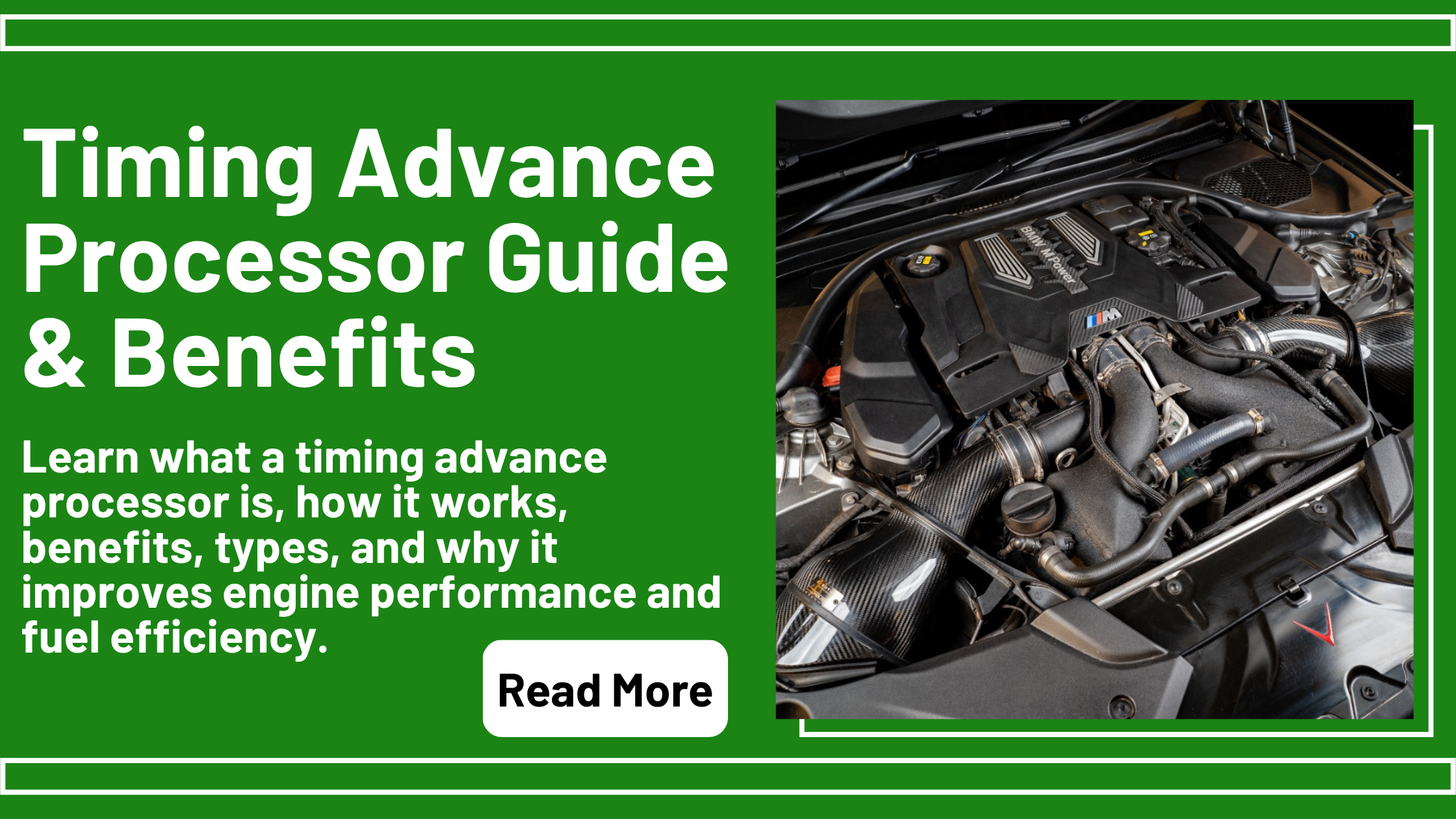
The present-day cars are dependent on the high level of accuracy in engineering and electronics to provide the best results. A Timing Advance Processor (TAP) is one of the most crucial elements of automotive tuning that is not looked at very critically. This equipment is very important in offering engine efficiency, increase in power production and fuel optimization. Any car fan, professional or amateur mechanic, or just a regular car driver, can learn about the functioning of a timing advance processor and, as a result, affect its performance greatly.
What Does A Timing Advice Processor Mean?
The Timing Advance Processor (TAP) is an electronic device that is applied in a vehicle to make the engine ignition timing adjustable.
👉 In simple terms:
It regulates the timing of firing the spark plug within the engine so as to have better performance and efficiency.
It functions by altering the signal between the engine sensors and ignition system and in so doing makes the air-fuel mixture ignite at the most efficient time.
The Importance Of The Ignition Timing
Ignition timing will decide the time of spark ignition of the air-fuel mixture within the engine cylinder. In case of the spark being premature, then there is engine knocking and damage. In case of late spark, then there is less power and efficiency.
The best time is one that will guarantee:
- Maximum combustion efficiency
- Better engine performance
- Lower fuel consumption
This is a perfect balance that is maintained dynamically with the assistance of timing advance processors.
Timing Advance Processor Workings
Timing advance processor is used by intercepting and altering engine signals.
Step-by-Step Working Process:
1. Signal Input
Sensors provide inputs to the processor and these include:
Crankshaft position sensor
Camshaft sensor
Throttle position sensor
2. Signal Modification
It modifies the signal to give the illusion that the piston is at another position to the engine.
3. Adjusted Ignition Timing
This will either advance or retard the firing of the spark plug.
4. Real-Time Adjustment
The processor keeps on changing according to:
Engine speed (RPM)
Load conditions
Fuel type
This is so fast, as it occurs in milliseconds, which provides maximum combustion at any given time.
The Main Processor Functions Of A Timing Advance Processor
1. Adjust Ignition Timing
Adjusts when the spark is ignited.
2. Improve Combustion Efficiency
Makes sure that there is complete burning of fuel.
3. Lean to Alternative Fuels.
Most importantly in the conversions of LPG/CNG.
4. Prevent Engine Knocking
Avoids premature combustion.
5. Enhance Engine Performance
Presents a silky acceleration and power.
Advantages Of Operating A Timing Advance Processor
1. Increased Engine Power
Timing is done correctly to enhance the pressure of combustion leading to the improved horsepower.
2. Improved Fuel Efficiency
With the optimized timing, there is increased efficiency of fuel consumption and in most cases, the mileage would increase by 5-10 percent.
3. Better Throttle Response
There is more responsiveness to acceleration in the engine.
4. Reduced Engine Stress
Eliminates knocking and detonation extending engine life.
5. Capacity to be used with Alternative Fuels.
Necessary to operate vehicles with the LPG or CNG with maximum performance.
There Are Timing Advance Processors Of This Type
The analog timing advance processors are known as the first type.
Fixed timing adjustments
Simple and cost-effective
Limited flexibility
2. Digital Programmable Processors
Custom timing curves
Adjustable via software
Performance tuning Usage.
3. ECU-Integrated Systems
Fitted in the contemporary cars.
Automatically controlled
None of those externals required.
4. Aftermarket Processors
Installed separately
Famous with the automobile lovers.
Offer performance upgrades
Timing Advance Processor Model Populairities.
A number of sophisticated models are in the market particularly of the automotive electronic manufacturers.
The major characteristics of the devices in the present day include:
Adjustable timing curves (6°, 9°, 12°, 15°)
Programmable via PC
Co-exists with various types of engines.
Safety bypass emergency systems.
All these features enable them to be flexible in various cars and driving conditions.
Timing Advance Processors Have Been Used In The Following Applications
1. Performance Tuning
Applicable in sport cars and racing cars to give it maximum power.
2. LPG/CNG Vehicles
Enhances the efficiency of heating of the alternative fuel engines.
3. Daily Driving
Improves the fuel economy and the driving comfort.
4. Fleet Management
Assistance in saving fuel on a number of vehicles.
5. Off-Road Vehicles
Stocks engine performance in difficult driving conditions.
Installation Of A Processor Of Timing Advance
DIY Installation Steps:
- Disconnect the battery
- Find the ECU/ ignition system.
- Connect the processor
- Configure settings
- Test the system
- Professional Installation
Should be used in the sophisticated models that need tuning and calibration.
Timing Advance Processor Best Practices
1. Use High-Quality Fuel
Assures improved performance and combustion.
2. Follow Manufacturer Guidelines
Proper installation or tuning should not be done.
3. Regular Maintenance
Periodic performance of check system.
4. Monitor Engine Performance
Observe knock and abnormal behavior.
Combine with Other Upgrades: 5.
Comes with no problems with air intake and exhaust upgrades.
Challenges And Limitations
1. Incorrect Installation Risks
Poor configuration may decrease the performance.
2. Compatibility Issues
Aftermarket processors are not available in all vehicles.
3. Potential Warranty Concerns
Warranties of May void the manufacturer.
4. Requires Technical Knowledge
The high-end models require the skills of tuners.
Timing Advance Processor Ecu Tuning
Although they both are better in performance:
External device External device External device Timing Advance Processor → External device
Software modification Software modification ECU Tuning.
👉 TAP is simple to install and reversible hence is very popular with the users.
The Future Of The Timing Advance Technology
The timing control of the future consists in:
1. AI-Based Engine Optimization
Real-time intelligent adjustments.
The second step is integration with Smart Vehicles.
Car systems that are interconnected to be better controlled.
Adaptation of hybrid and alternative fuels.
More fuel efficient management systems.
4. Superior Sensors and Automation.
Greater accuracy and efficiency.
FAQs
Question 1. What is a timing advance processor?
It varies the ignition timing to enhance performance of the engine, fuel consumption and reliability.
2. Does a timing advance processor have a high level of safety?
Yes, it is true that when properly fitted, it lowers the engine stress and it enhances performance.
3. What will be my level of performance improvement?
Increased throttle response and large improvement in horsepower (5-15 horsepower).
4. Am I able to do it on my own?
Simple models may be installed by the DIY, and sophisticated models are to be setup by the professionals.
5. Does it have better fuel efficiency?
Admittedly, most users claim 5-10 miles of higher mileage.
Conclusion
The Timing Advance Processor is a component that has great power but is not given much attention and can greatly enhance the performance of the engine as well as its efficiency and reliability. It also makes sure by optimum ignition timing:
- Better combustion
- Increased power
- Improved fuel economy
A timing advance processor is a smart addition to every person who wants to improve the performance of the vehicle but without doing any significant mechanical alterations.