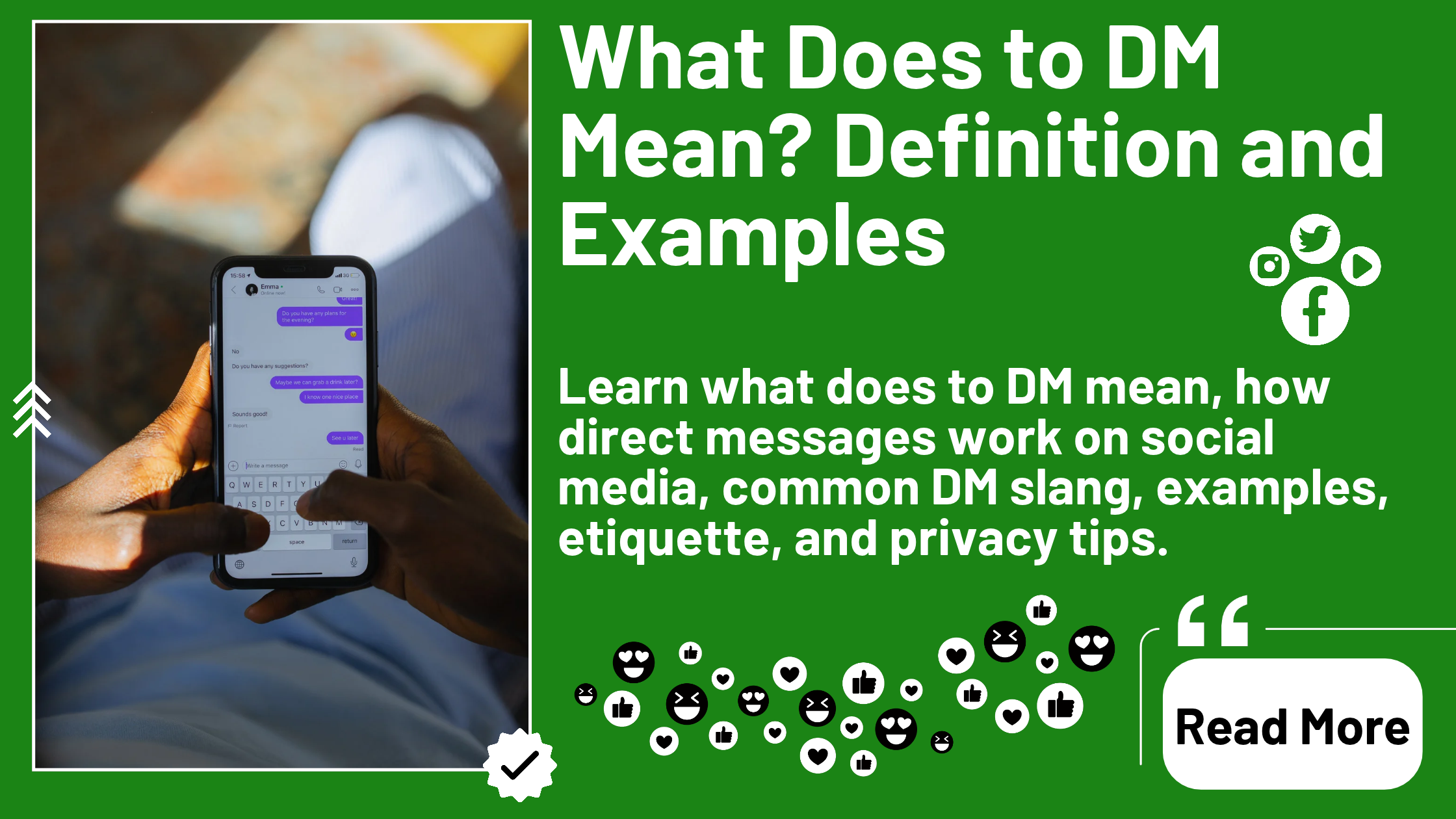
What Does To DM Mean? A Complete Guide To What Does To DM Mean
Have you ever heard people say ‘DM me,’ ‘check your DMs,’ or ‘slide into my DMs’ on social media and wondered what these mean? It is important to know What Does To DM Mean because this acronym is used often in online discussions, text messaging, comments and on social media. DM means a direct message, a private message sent to an individual through social media and/or an online service. DM has also been adopted both as a noun and verb, says USA Today: It can mean a private message somebody receives, or it can be the process of sending that private message. Yespo also clarifies the role direct messages have in personal communication and business communications via social media. (USA Today, Yespo)
So What Does To DM Mean?
“To DM” is short for a Direct Message, meaning to send someone a private message on a social media site. Public comment or posting may not be an option; instead, you call up a specific person with the platform’s messaging system so that only he or she can see your post.
For instance “I will DM you the details” means that they will send the info directly to your Inbox. When a business writes, “DM us for more information,” it’s asking people to enter into a private conversation with the business.
Very popular across platforms such as Instagram, Facebook, X (formerly Twitter), TikTok and LinkedIn. Each platform uses a slightly different term or series of terms and the different features provided for messaging and different level of privacy afforded, but the gist of the concept is the same – a direct message is a message that is intended for a specifically chosen receiver, rather than a public audience. (USA Today, Yespo)
What Does To DM Mean Stand For?
DM Means direct message. This is a type of communication that enables private messages to be sent to other accounts via the internet.
The abbreviation will be used differently in sentences:
The nD2m is used as a noun: “I got a DM from a friend.” DM in this case is a message.
As a noun: “Put a DM tonight! In this case, DM refers to the process of sending a message.
As a plural: “I don’t have just one DM, I have many.” In the case of multiple direct messages (DMs), here refers to more than one DM.
In this guide to the meaning of DM USA Today, these uses of the nouns and verbs are clarified. The abbreviation has grown popular since it is easier to use than simply typing “direct message” in an on-going online discussion. (USA Today)
This Blog Shows You How To Create A Direct Message.
A private, or direct, message or communication via a social networking service or other Internet service that provides direct message capabilities.
Unlike a public comment, the DM is usually only viewable by the account(s) involved in the discussion and/or the account safety; assistant user. The ability to send text, photos, videos, links, voice messages and more, depending on the platform.
Use direct messages for specific personal attention, context and other information that would not be deemed public. Fans can communicate privately with others in DMs and companies can respond to customer inquiries and talk about products and services. (Yespo)
But simply because a DM has been provided, it should not be assumed that it will always be totally confidential. Recipients can view and take screenshots or copies or forward the messages and privacy levels vary based on the platform and its user settings.
How To Use DM In Everyday Conversations
Many people find themselves flustered with the correct use of DM, but if they find out, that can make online conversations easier, and more natural. The abbreviation is common when making plans, giving instructions, asking questions or redirecting a discussion from the public comments section.
Some common examples of where they can be found in everyday life are:
Example 1: Sharing information
“OK, I’ve found your site! I’ll DM you the link!
This will mean the presenter will share the link on their own.
Rather, one way to help strengthen this point is to pose a question to the audience.
If you have any questions about the event, just PM me.”
This encourages somebody to connect with the individual via direct message.
Example 3: Following up
“Oleadia”, you will ask, “Did you get my DM yesterday?”
This is a question for the recipient to answer: ‘Did you receive a private message?
Example 4: Personal communication
Be sure to DM her when you get home.
This means that the speaker will direct a private message later.
Example 5: Business communication
Escriba AQUÍ la aplicación Instagram si quiere conocer más detalles del producto.
This is the kind of message that encourages potential customers to reach out to the company in a private manner to find out more details.
These are only some of the uses for DM: casual conversations, professional communication, and customer service.
Explain What Does To DM Mean.
DM me” is an abbreviation that stands for “direct me a message”. An expression employing when one wants another to call them “in private” and not in public.
Suppose someone creates a post on their new project and includes, “DM me if you want to contribute. Interested allies can contact the student through an invitation to them in a private message.
A small business may write “DM us for pricing” and have customers contact them in their social media inbox for more detail.
The sentence is simple and conversational. It’s particularly prevalent on social sites where public posts and personal messaging occur in the exact same application.
What Is Meant By “Slide Into The DMs”?
“Slide into the DMs” is a casual way to say chatting an individual through social media privately, typically to show a romantic interest in or start up a flirtatious conversation.
Say, for instance, “he approached her via her DM after seeing her post. This indicates he sent her a private message, presumably to get to know her.
When you use the word “Jezebel,” that doesn’t necessarily mean you’re flirting. It can also be used to mean a spontaneous interaction or addressing someone. This is because the intended meaning varies due to different contexts.
In the event that an unsolicited message may seem invasive, it is essential to honor people’s boundaries. Repeated messages to the unengaged are generally not needed and are more apt to be read as being “mickey,” or “cute,” than a friendly, relevant one.
What Does Check Your DMs Mean?
To open your Direct-Messages section in order to find a private message you were sent.
For instance, a pal could send out, “I’ve shared your address, look in the DMs.” This posting has not been posted in the public comment section, but is private.
On some platforms, messages may be sent to you by people you don’t follow that may be kept in a separate message-request folder. If no such message has been found, please go to the Inbox folder and ensure you are working on the right account.
Understanding DM – It Is Where Instagram And Facebook And Tiktok Come Into Play.
While the concept of DM is similar on most social media sites, many services come with specific rules and interface labels for such communication.
DM on Instagram
DM on Instagram is typically a private message that is sent using Instagram’s messaging service. Users may share text, posts, Reels, photos, videos, and more.
For instance, “DM me your favorite song” indicates that the individual is asking for you to send them a copy of your favourite song or information about it privately.
DM on Facebook
In Facebook, people can send PMs using DM within the messaging feature. Depending on what they’re talking about, they might also type “send me a message” or directly mention “Messenger”.
As an example, when someone says “DM me if you want to join the group”, they are referring to communicating with that person privately.
DM on TikTok
In TikTok, DM is short for direct message, which are the messages sent through the TikTok Messaging service. Users can use it to share content or send messages to friends or followers, as per the current messaging eligibility and privacy policies for TikTok.
For instance, ‘snd me the video you’re talking about’ would indicate that you should send a private message.
DM on X and LinkedIn
DM is not a message posted in public forums or a ‘reply’, but a private message on X. It’s usually part of a LinkedIn private business message for connecting with a business owner, establishing a professional meeting, asking a business-related question, or working together.
All of these services share the same terminology but not all access rules and features are equally available. (Yespo)
How is it that there is a difference between DM and PM?
DM = Direct message and PM = Private message. These two terms refer to communicating for specific audiences and not a mass audience.
DM is particularly suited for social media communications and PM is a lot seen in online forums, game communities and other messaging contexts.
The words may be used interchangeably in everyday conversations. The term that is preferred will vary by platform and community.
What’s The Purpose Of Direct Messages?
Direct messages are used by people for all sorts of reasons, including the fact that it is easier to pass along information that way then to share it all publicity.
Common reasons include:
Personal conversations: Friends and family members can message each other, send pictures and links.
Sharing information: Users can send information that is more relevant to a specific person.
Social networking: introduce, connect with and converse about shared interests with others.
Professional Communication: Colleagues, Creators, and Business Contacts can communicate about projects and opportunities.
Customer support in business can be answering customer questions, assisting customers with products or services.
Sales and marketing: Companies can deal with inquiries and supply suitable product info without creating public discourse.
The role of DMs in personal communication, customer support, lead generation and business engagement are highlighted by Yespo. (Yespo)
How To Write A Polite DM (Direct Message)
Learning What Does To DM Mean is just the preliminary step. Knowing what to say or not say is an effective way of communicating respectfully.
Put a clear greeting at the beginning if necessary.
When it’s your first time reaching out, start with a simple greeting and provide a limited amount of information regarding your contact.
For instance: “Hi, i saw your photographing post and wanted to ask something about camera set up.
Focus on relevant topics by making sure the relevant information comes across.
Don’t use too many long and complicated messages, these can convey the same information as a few sentences. Be clear in your intention and give sufficient background to the recipient so that they know what you want.
Respect Personal Boundaries
People aren’t everyone, and they may not respond right away to messages from people they don’t know. Do NOT send messages to someone again if there is no response or coerce them to reply.
Avoid Spam
Multiple messages for the same recipients can turn off recipients and may be against platform policies. If it’s to do with any business, customize your message/make it relevant.
Protect Your Privacy
Avoid sharing passwords, verification codes, bank information or irrelevant sensitive data via social media options. Take caution of any funds requested on the internet or links that are suspicious.
Direct messaging is a communication channel and not an indication of trustworthiness of the recipient or the content.
Does a DM Private and Safe?
Generally, direct messages are meant for people who are interacting in the conversation, although their level of privacy varies with the platform, its settings and the nature of the conversation.
A message shouldn’t be considered to be impossible to share. Whether the recipient takes a screen-shot, copies the text or forwards, it is ok. Other services offer message requests, reporting utilities, blocking and other privacy options.
To communicate more safely, check your message controls, be careful of strangers, and don’t provide personal or financial details. Handle no suspicious messaging by clicking on unknown links or giving information.
Clear messaging policies and respectful communication can promote trust and minimize spam and privacy violations for business accounts.
Frequently Asked Questions
In texting What Does To DM Mean?
Direct message: Send a private message to someone on social media or other online communication platform. For instance, an obligation to “I will DM later” is an obligation to send a DM in the future.
What is the meaning of “DM”?
“Direct message,” or DM, is a message that is sent to only one person. It’s a private communication intended for a specific person or group and not for the general public.
So What Does To DM Mean when it comes to social media?
DM (direct message) is the term for sending a direct message to someone. Offers to speak with person who sent the message privately at the platform’s messaging service.
So what does it imply when it’s a message that you slide into the DMs?
You “Slide into someone’s DMs” when you start talking privately by using social media with another user. It is often used refer to flirting or romantic interest, but it can also be used to refer to casual or friendly contact.
DM = private message?
In most cases, where social media is understood in its popular usage, DM and private message are essentially interchangeable terms. In this case, DM indicates a direct message while a PM is generally a private message.
Conclusion
Knowing What Does To DM Mean that you can better understand one of the most used expression in communicating through online. DM – short for “direct message” – is a private message that one sends via social media to a different user and performing the act of sending such a message is known as DMing. Sayings like DM me, check your DMs, and slide into the DMs are utilized in different consensual connections, circles of companions, and business correspondence. While direct messages are typically for a group of chosen recipients, people need to show respect of boundaries and avoid spam and protect sensitive information in direct messages. After you grasp the sense of DM, you’ll be more at ease and natural when dealing with discussions that you usually engage in each day on social media.

Alexander Carter is a veteran technology strategist, writer and systems architect, with more than a decade and a half of hands-on experience at the intersection of emerging software paradigms, cloud architecture and digital transformation. Alexander has always been fascinated by how technology affects human capability and evolved into a demystifier of complex technology environments and helper of organizations to create scalable, resilient systems for the modern era.