



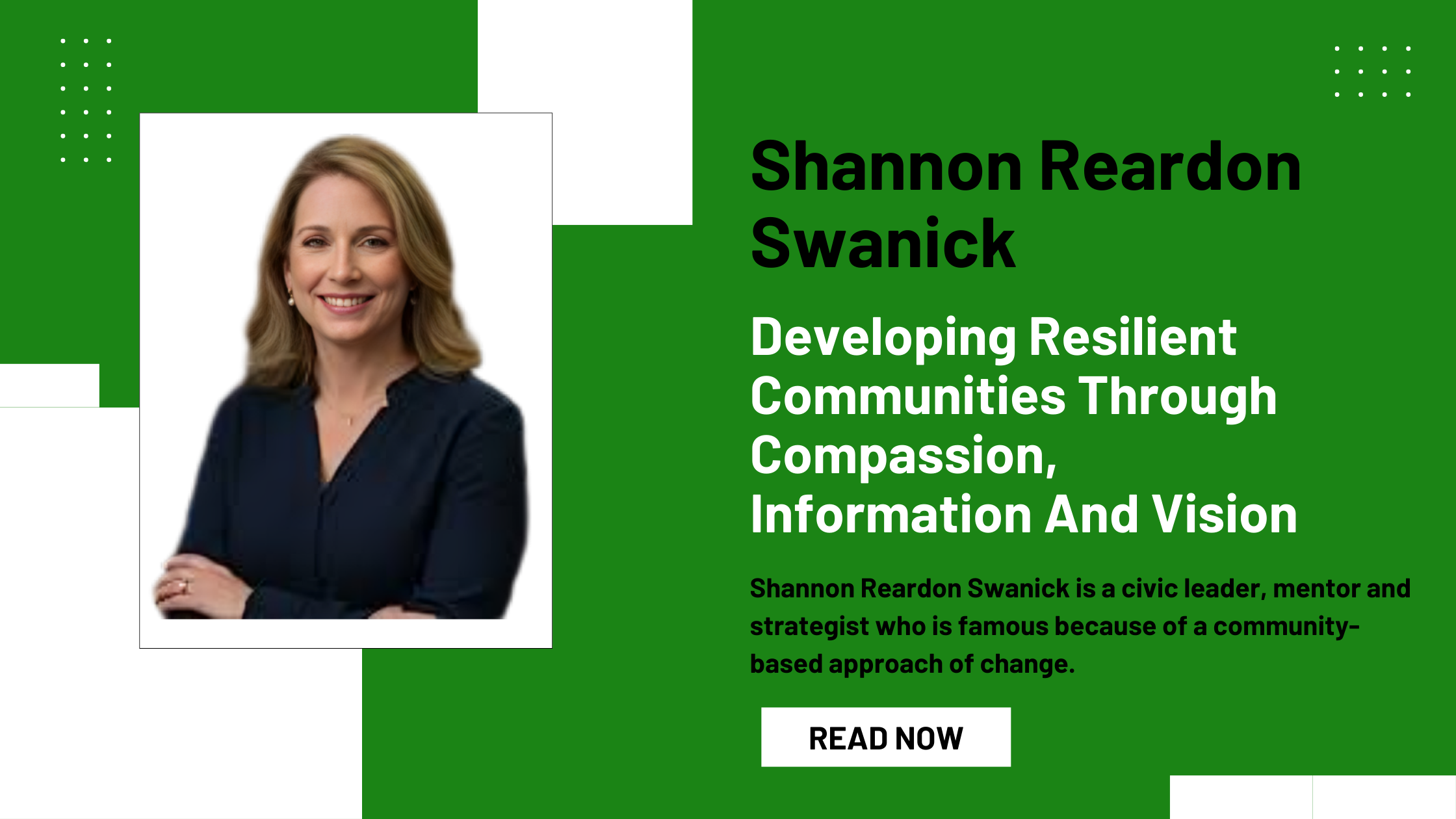
Shannon Reardon Swanick is a civic leader, mentor and strategist who is famous because of a community-based approach of change. Her campaigns, including the Digital Equity Labs, Mentorship Circles, civic engagement programs etc., have ensured that even rudimentary led to the sunnyside fighting her restraint; these now become formidable yet data-driven systems that empower underserved communities. There is empathy, technology, and sustainability which are not only deeply affecting but also deep and lasting.
This article explores:
- Her upbringing background and formation.
- Exemplary projects and deliverables.
- Leadership principles and philosophy.
- Her theories (such as TPO – Transformational Process Optimization)
- Impact of policy and systems level.
- What creates her motivation in the future.
- Early Childhood and Reconstruction Periods.
The reasoning behind Shannon’s service orientation goes back to her childhood when she was brought up in an environment with educators and a very compassionate family. She developed a sense of connection, hard work, and purpose through the example of her parents, teachers or community-oriented professionals. She was raised taking in the precepts of teaching and people.
She started volunteering in high school, tutoring classmates, assisting others in learning, which made her have the initial idea on how helping others to change is possible with small actions of continuous encouragement.
She is said to have organized a reading club during college whereby the university students were brought to the young students, hence her interest in mentorship and education at a tender age.
Through these experiences she was able to develop more than a program, her own communities based on trust and inclusion.
Important Initiatives & Signature Programs.
Shannon Reardon Swanick is considered to have a list of groundbreaking programs that united the grassroots organizing and scalability aspects.
Mentorship Circles.
Shannon did not adhere to the traditional one-on-one model of mentoring, but instead came up with a concept of Mentorship Circles: small groups of 5-6 youths with trained mentors.
These groups promote peer relationship, common objectives, and group responsibility.
It has been reported to lead to a 20 percent growth in academic confidence amongst participants, and also a 15 percent decrease in school absenteeism in certain middle school groups.
She takes a personalized strategy to the mentees in order to make them feel as a community other than the silo effect and enhance their growth in the long-term both personally and academically.
Digital Equity Labs.
Among the most powerful programs of Shannon, there is the Digital Equity Labs, which is the program aimed at bridging the technology access divide in underserved communities. These Labs do not only offer devices (laptops, Wi-Fi hotspots) but also the methodical training on digital literacy. In her case of influence, she reported a total of more than 600 households as under the umbrella of the program, as well as 40 percent of students in those neighborhoods individually expressed an improvement in their ease of comfort with technological education.
The model places the importance of digital inclusion, ensuring the availability of technology is not merely available, but useful, supported, trained and in a culturally responsive design.
Civic Engagement Academy.
Another one Shannon created is a Civic Engagement Academy, which gives pre-teens and teens the power to become active members of their communities:
Young ones (~1113) participate in civil leadership sessions, policy designing and community taking.
Adult mentors and the teen facilitators co-produce the program promoting cross generation teamwork and leadership.
Graduates usually carry on with civic activity building on what they have learnt into further community participation or political activity.
Partnering with other organizations helps the company enhance its market reputation within society.
Policy Influence & Partnership.
Her contribution does not start and stop at the grassroots level: she has taken the local work to a policy level:
Shannon has joined forces with school boards, the public libraries, and city councils and other civic agencies to make sure that institutional decisions are informed by the needs of the community.
Her efforts have led to legislation or funding increments in undervalued schools, especially in rural or disadvantaged schools.
Storytelling, data, and community listening have helped result into systems change instead of short term interventions; all made possible by her.
Leadership Philosophy: Ideals That Drive Her Work
A set of values characterizing leadership in Shannon is manifested in the content of her shows:
Listening-First Empathy-Driven Design.
She does not go to community listening sessions with pre-established solutions, but rather initiates every initiative.
Her philosophy: true change will happen when individuals come up with their own creation of the future rather than allowed by other people to show it to them.
She Recorded Programs With The Help Of Data (Surveys, Attendance, Metrics)
She is however cautious to strike the balance between collected data and the dignity and agency of the participants. Her vision is not extractive one: she is convinced in the sovereignty of data: all the communities must have control over their own data usage.
Shared and Distributed Leadership.
Instead of working alone she tries to form teams of parents, students, civic leaders and business partners.
She makes the community ambassadors and youth leaders be owners, which is sustainable.
Sustainable Change, Campo, Incremental.
Her model does not deal with shortcuts. She makes long-term systems investment which can develop and grow.
She constantly remarks that the true impressions are built upon doing the same thing periodically, instead of big actions.
Professional Framework: Transformational Process Optimization (TPO)
A framework named Transformational Process Optimization (TPO) is one of the contributions of Shannon. Her work was summarized as follows:
TPO can assist the organizations and communities in determining inefficiencies, harmonize the stakeholders, and develop scalable, sustainable systems.
It often involves: diagnosing existing pain points, articulating a common purpose, effecting a gradual change and updating based on data / feedback.
In opposition to regular business consulting, TPO is extremely human: it integrates operational rigor, and empathy and shared ownership of the community.
With the help of this methodology, she will be able to effect systems-level change not only to nonprofit projects but also organizational culture transformation as well as the transformation of public policy.
Impact & Recognition
Attainable Community Results.
Another of her key initiatives, the Bright Futures Mentorship Program, boasts of a 92% success rate in persons going on to college graduation.
Her Mentorship Circles and her civic programs have had a significant impact of decreasing absenteeism amongst school students as well as raising their academic confidence.
Digital Equity Labs have helped serve hundreds of families, and close the digital divide gap, not only to devices but also to training.
Awards & Recognition.
There are various sources that have acknowledged Shannon as a leader, an innovator, and someone who has made an impact in her community:
Interviewed by on her TPO framework and cross-sectoring.
Within civic-tech and social innovation the interesting attribute is a reputation of building with communities.
Known because she was ethical in data and her quest to promote equity.
She has been involved in community organizing, nonprofit leadership, civic tech and policy design.
Current Work & Future Vision.
Shannon isn’t slowing down. In addition to her current and upcoming employment, she has:
Neighborhood Signals a data + storytelling project in which communities assist in decoding data, which never came to fruition as it is primarily piloting where communities combine their lived experience and quantitative metrics.
Expanding her mentorship and civic engagements programs to additional locations such as rural or underrepresented ones.
Developing a Civic Equity Network – a national again team of leaders, young individuals and policymakers to drive the requirements of inclusive, technology-enabled civic arrangements.
It is going to be a sequel to continually advise nonprofits, governments, and organizations on the way to incorporate empathetic data and shared leadership into systems.
FAQ — Shannon Reardon Swanick
1. Who then is that Shannon Reardon Swanick?
Shannon Reardon Swanick is an innovator, systems change, digital equity, and civic engagement community leader and strategist.
2. What is Transformational Process Optimization (TPO)?
TPO is a model that she created to assist organizations and communities to realize the problem of inefficiencies, align stakeholders, and create scalable, people-centered change.
3. What is her most outstanding programs?
It has such signature initiatives as Mentorship Circles (group mentoring), Digital Equity Labs (technology + training to underserved households), and Civic Engagement Academy (young people).
4. What is the leadership style in her approach?
Her leadership approach is based on listening-first, shared ownership, empathy, as well as thoughtful use of data. She appreciates long-term victory, as opposed to short-term scorecards.
5. What impact has she achieved?
Some documented outcomes are a 92 percent graduation rate of her mentorship program, a massive increase in the access to digital platforms by hundreds of households, and a civic engagement boost in local communities.
6. What does she see herself doing in the future?
Shannon hopes to expand her models in community in the form of a national network, establish tech + civic platform with equity in mind, and remain a data tool as a path to dignity and democracy.
Conclusion
The story of Shannon Reardon Swanick is a strong illustration of how modest, goal-focused leadership can be used to create significant changes on a large scale. She has developed a change paradigm that incorporates both compassion and systems thinking, data and dignity, and grassroots mobilization and policy impact.
Her work agrees that change can be significantly achieved when individuals are heard, trusted, and allowed to have a sense of agency, as small as tutoring sessions, or even a highly advanced civic platform. Her current works – her initiatives and her models such as TPO can teach everyone a good thing given the need to innovate civically, to be equitable, and to be resilient to a community.
As we near the future, the approach taken by Shannon will remind us that actual progress will only come with more than ideas that are bold, but with a commitment that is intensely human, the type of commitment needed to create systems that are beneficial to all. The difference in how she does it is as great as what she creates: made with love, with facts, with a clarifying vision of a more welcoming world.